Two pioneering women from Spain and Morocco recognized for their transformative work in sustainable food systems
PRIMA is proud to announce the winners of the 2nd edition of the Woman Greening Food Systems Award, a prize celebrating women who are reshaping the future of food across the Mediterranean region.
The first winning initiative combines practical solutions to water scarcity with long-term systemic change with free trainings, preparing the ground for quick adoption of sustainable practices while the second inititative combines urgent biodiversity rescue with community-centered science, protecting both Morocco’s genetic heritage and the food systems that depend on it.
Get to know the winners now:
The Winners:
Andrea Abad Bartolome (Terra Viva, TVI), Spain.
For her initiative: Farming the Future: Innovation, Education, and Regeneration in Action
Focusing on tackling Mediterranean water scarcity, Andrea Abad Bartolome has developed a smart irrigation system with the CERES Foundation that uses IoT sensors and weather data to help farmers automate watering based on real-time need, cutting water use while boosting crop resilience.
The technology is open-access, with free training to lower barriers to adoption.
She also leads TerraCert, an Erasmus+ project bringing together nine partners across five countries to create Europe’s first regenerative agriculture certification linked to micro-credentials and Europass. The project will be launched soon, and will offer 21 modular courses and digital credentials recognized across the EU, equipping a new generation of farmers with verified skills in agroecology, soil science, and sustainable business practices.
In her vision, she place the people at the center of her actions:
“This journey has taught me that innovation is not only about tools and technology, it’s about people. It’s the courage to change paths, the strength of farmer-to-farmer learning, and the power of turning degraded landscapes into thriving systems, one seed, one system, and one story at a time”
Kaoutar Aboukhalid (Institut National de la Recherche Agronomique), Morocco.
For her initiative: MOROREGEN, Conservation and Sustainable Valorization of Moroccan Oregano: From Wild Populations to Cultivation and Habitat Restoration
Khaoutar Aboukhalid is leading MOROREGEN, a cross-border scientific initiative to save Morocco’s endangered endemic oregano species from extinction. With four native oregano varieties facing severe threats from overexploitation, climate change, and habitat loss, her project combines field research with local knowledge to protect and restore these plants that are vital to traditional medicine, local economies, and ecosystem health.
Working with Moroccan and French partners, she’s developing a replicable model for conserving underutilized plant species while supporting the communities that depend on them. The work addresses both immediate biodiversity loss and long-term food system resilience in a region where 20% of plant species are found nowhere else on Earth.
She placed the science and woman at the center of her mission: saving an endangered endemic species from our region:
“The project adopts a field-based scientific approach rooted in local socio-ecological realities. It aligns with PRIMA’s vision of sustainable, climate-smart, and socially inclusive agriculture and offers a replicable roadmap for the conservation and valorization of underutilized plant species, demonstrating how women-led science can green the Mediterranean food system while safeguarding its unique biodiversity.”
These two winners embody the multi actor approach needed to address the Mediterranean’s food system challenges, and they demonstrate that sustainable change requires both innovation and conservation, new tools and traditional knowledge.
Let’s meet the inspiring winners changing the game in food systems:
Marta Cortegano (Portugal): fighting desertification through community power
Forestry Engineer Marta Cortegano, co-founder of Terra Sintrópica association, has been recognized for her project “BLOOM – Building Lives of Optimism and Opportunities for Women in the Semi-arid through Regeneration.” Working in Mértola, Portugal, one of Europe’s most sparsely populated regions, Marta Cortegano leads initiatives to combat desertification and land abandonment. Her project implements collaborative governance models that foster community capacity-building and agroecological transition, creating positive impacts across social, natural, and financial dimensions. Marta and her team seek a community process with care as its core value. Caring for the soil, the people, and the future, assuming sustainability of the agrifood system as the matrix of the territory’s biophysical and socioeconomic regeneration.
Dr. Thoraya Seada (Egypt): revolutionizing carbon markets for small farmers
As director of the Carbon Footprint Center at Heliopolis University for Sustainable Development, Dr. Seada received the award for her project “HU Egyptian Women Green Food.” Her leadership has been instrumental in developing whole-system carbon credit projects within the Economy of Love (EoL) framework, particularly benefiting small-holder farmers. Over the years Mrs. Thoraya has built a dedicated team of young women to work on whole system carbon credit projects within the EOL. The initiative has successfully integrated 5,000 smallholder farmers into the global Voluntary Carbon Market, significantly improving their annual income.
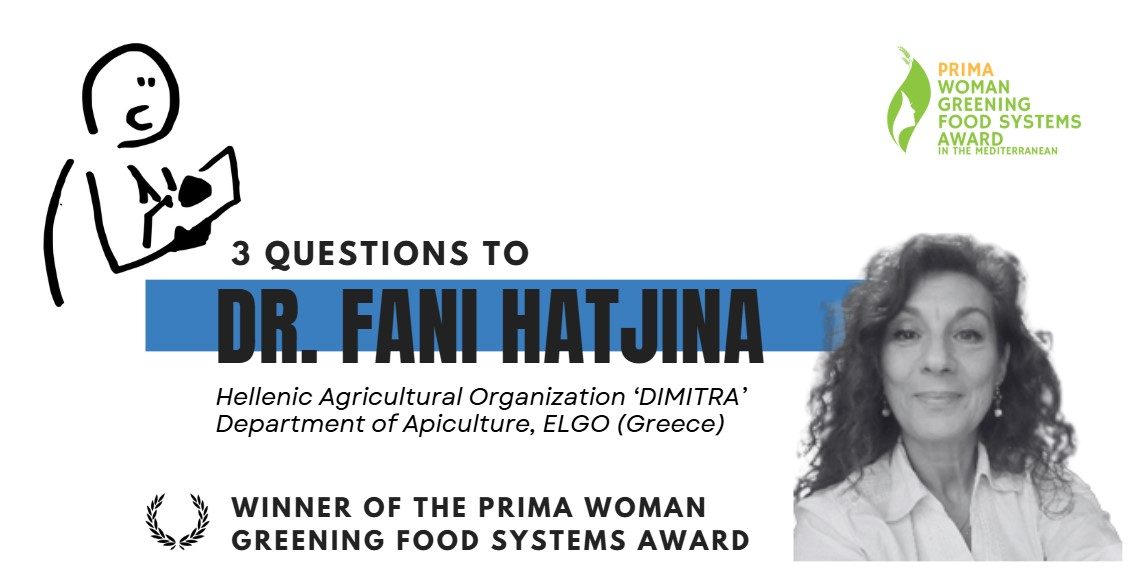
Dr. Fani Hatjina (Greece): Securing the Future of Mediterranean Pollinators
Biologist and bee expert Dr. Hatjina, from the Hellenic Agricultural Organization ‘DIMITRA’, was awarded for her “SafeAgroBee” project (funded by PRIMA). This initiative focuses on safeguarding agroecosystem resilience through efficient pollination and sustainable beekeeping. The project develops innovative monitoring tools and precision apiculture systems while investigating the adaptability of local honey bee populations under climate change conditions. The project also pioneers a unique Citizen Science approach, engaging local communities and stakeholders in bee conservation while developing a novel Health Status Index to predict bee colony productivity and pollination service efficiency.
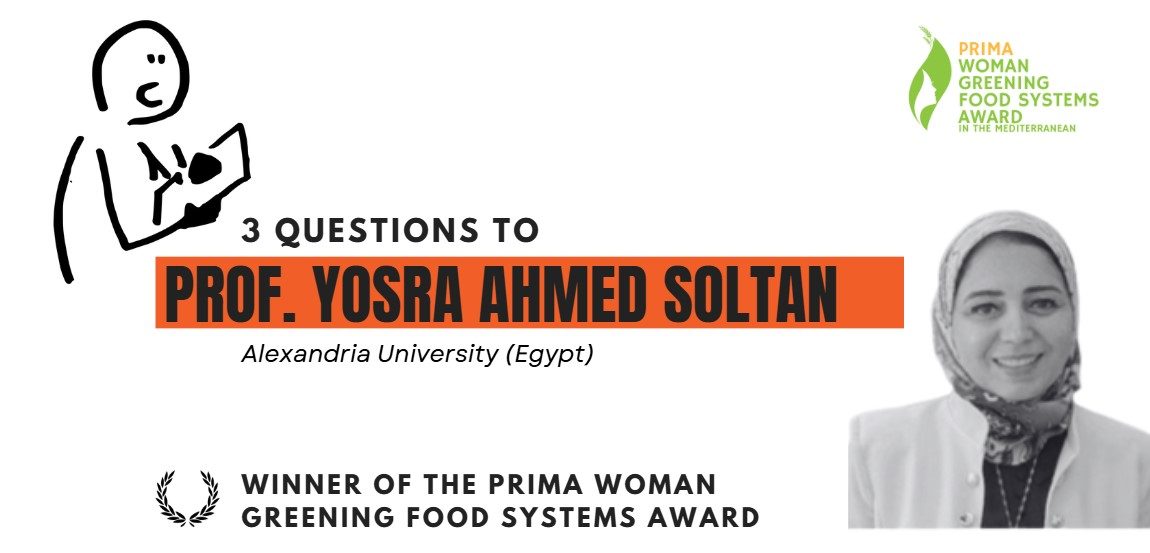
Prof. Yosra Ahmed Soltan (Egypt): Reducing livestock emissions while increasing production
Professor of Animal Nutrition at Alexandria University, Prof. Soltan was recognized for her project “Mitigating Livestock Greenhouse Gas Emissions: Innovations and Impacts” (MLGHG). Her team has developed natural solutions to reduce methane emissions from livestock, including modified clays that cut methane production by up to 60% and biochar supplements that reduce emissions by 20% while increasing milk yield by 12%. These innovations particularly benefit women smallholder farmers by enabling safer and more productive livestock management.
—–
These winners represent the fundamental role women play in developing sustainable solutions for food systems in the Mediterranean region, from soil regeneration and reduction of carbon footprint to livestock emission management and the conservation of bees illustrating the many angles from which resilient food systems of the future must be built.
Let’s meet the inspiring winners changing the game in food systems:
Marta Cortegano (Portugal): fighting desertification through community power
Forestry Engineer Marta Cortegano, co-founder of Terra Sintrópica association, has been recognized for her project “BLOOM – Building Lives of Optimism and Opportunities for Women in the Semi-arid through Regeneration.” Working in Mértola, Portugal, one of Europe’s most sparsely populated regions, Marta Cortegano leads initiatives to combat desertification and land abandonment. Her project implements collaborative governance models that foster community capacity-building and agroecological transition, creating positive impacts across social, natural, and financial dimensions. Marta and her team seek a community process with care as its core value. Caring for the soil, the people, and the future, assuming sustainability of the agrifood system as the matrix of the territory’s biophysical and socioeconomic regeneration.
Dr. Thoraya Seada (Egypt): revolutionizing carbon markets for small farmers
As director of the Carbon Footprint Center at Heliopolis University for Sustainable Development, Dr. Seada received the award for her project “HU Egyptian Women Green Food.” Her leadership has been instrumental in developing whole-system carbon credit projects within the Economy of Love (EoL) framework, particularly benefiting small-holder farmers. Over the years Mrs. Thoraya has built a dedicated team of young women to work on whole system carbon credit projects within the EOL. The initiative has successfully integrated 5,000 smallholder farmers into the global Voluntary Carbon Market, significantly improving their annual income.
Dr. Fani Hatjina (Greece): Securing the Future of Mediterranean Pollinators
Biologist and bee expert Dr. Hatjina, from the Hellenic Agricultural Organization ‘DIMITRA’, was awarded for her “SafeAgroBee” project (funded by PRIMA). This initiative focuses on safeguarding agroecosystem resilience through efficient pollination and sustainable beekeeping. The project develops innovative monitoring tools and precision apiculture systems while investigating the adaptability of local honey bee populations under climate change conditions. The project also pioneers a unique Citizen Science approach, engaging local communities and stakeholders in bee conservation while developing a novel Health Status Index to predict bee colony productivity and pollination service efficiency.
Prof. Yosra Ahmed Soltan (Egypt): Reducing livestock emissions while increasing production
Professor of Animal Nutrition at Alexandria University, Prof. Soltan was recognized for her project “Mitigating Livestock Greenhouse Gas Emissions: Innovations and Impacts” (MLGHG). Her team has developed natural solutions to reduce methane emissions from livestock, including modified clays that cut methane production by up to 60% and biochar supplements that reduce emissions by 20% while increasing milk yield by 12%. These innovations particularly benefit women smallholder farmers by enabling safer and more productive livestock management.
—–
These winners represent the fundamental role women play in developing sustainable solutions for food systems in the Mediterranean region, from soil regeneration and reduction of carbon footprint to livestock emission management and the conservation of bees illustrating the many angles from which resilient food systems of the future must be built.
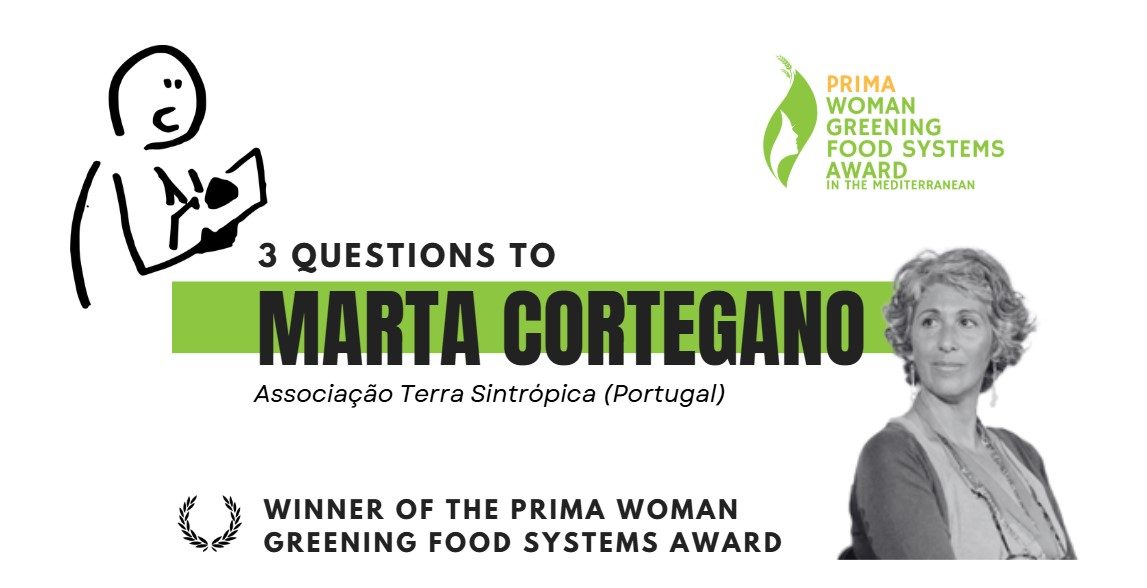
One of the four winners of the PRIMA Award for Women Greening Food Systems, Marta Cortegano is leading the fight against desertification in Portugal’s semi-arid landscapes. As part of our series spotlighting these inspiring women, we asked her three key questions to learn more about her vision and impact.
Across the Mediterranean, women are transforming food systems for a more sustainable future. Among them is Marta, a forestry engineer and co-founder of Associação Terra Sintrópica. Her initiative, BLOOM – Building Lives of Optimism and Opportunities for Women in the Semi-arid through Regeneration, is reversing land abandonment and environmental degradation in Mértola, one of Europe’s driest and most depopulated regions.
By fostering collaborative governance and agroecological practices, Marta and her team are not only restoring the land but also strengthening the communities that depend on it. At the heart of her vision is care—for the soil, for the people, and for the future.
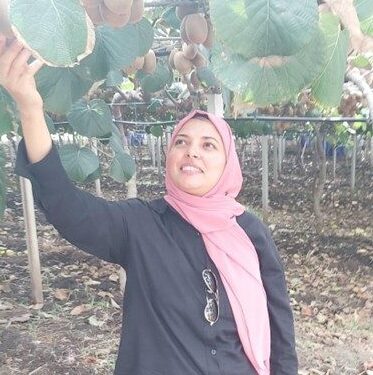
One of the four winners of the PRIMA Award for Women Greening Food Systems, Dr. Thoraya Seada is leading the change in revolutionizing carbon markets for small farmers in Egypt. As part of our series spotlighting these inspiring women, we asked her three key questions to learn more about her vision and impact.
Across the Mediterranean, women are redefining how we tackle climate change and support sustainable food systems. Dr. Seada, as the director of the Carbon Footprint Center at Heliopolis University for Sustainable Development, is at the forefront of this transformation. Her project, HU Egyptian Women Green Food, is empowering small-holder farmers through carbon credit systems within the Economy of Love (EoL) framework, helping them access the global Voluntary Carbon Market and significantly boosting their incomes.
By leading a team of dedicated young women, Dr. Seada has been instrumental in integrating over 5,000 smallholder farmers into these carbon markets, creating a sustainable economic model that benefits both the environment and the people who rely on it.
One of the four winners of the PRIMA Award for Women Greening Food Systems, Dr. Fani Hatjina is pioneering efforts to safeguard agroecosystem resilience through sustainable beekeeping in Greece. As part of our series spotlighting these inspiring women, we asked her three key questions to learn more about her vision and impact.
Across the Mediterranean, the importance of pollinators is becoming more evident as climate change threatens biodiversity and food security. Dr. Hatjina, a biologist and bee expert from the Hellenic Agricultural Organization ‘DIMITRA’, is tackling this challenge head-on with her SafeAgroBee project. Focused on efficient pollination and the sustainability of beekeeping, the project is developing innovative monitoring tools and precision apiculture systems to better understand and protect local honey bee populations in the face of climate change.
By engaging local communities through Citizen Science and creating a Health Status Index to predict bee colony productivity, Dr. Hatjina and her team are ensuring the future of Mediterranean pollinators and the ecosystems that depend on them.
One of the four winners of the PRIMA Award for Women Greening Food Systems, Prof. Yosra Ahmed Soltan is leading an impressive work to reduce livestock greenhouse gas emissions while boosting production in Egypt. As part of our series spotlighting these inspiring women, we asked her three key questions to learn more about her vision and impact.
In the face of climate change, Prof. Soltan, a Professor of Animal Nutrition at Alexandria University, is tackling one of agriculture’s most pressing challenges: mitigating methane emissions from livestock. Her project, MLGHG – Mitigating Livestock Greenhouse Gas Emissions: Innovations and Impacts, has introduced natural solutions such as modified clays and biochar supplements that significantly reduce methane emissions—by up to 60% and 20%, respectively—while improving milk yield by 12%.
These innovations are especially transformative for women smallholder farmers, providing them with safer and more productive livestock management techniques.
The PRIMA WEFE Nexus prize was awarded during a side event organized by PRIMA, in the Med Pavilion at COP 27, in Sharm El Sheik.
HYDROUSA project
Dr. Simos Malamis
One Nexus Project
Prof. Rabi Mokhtar
| Cookie | Duration | Description |
|---|---|---|
| cookielawinfo-checkbox-analytics | 11 months | This cookie is set by GDPR Cookie Consent plugin. The cookie is used to store the user consent for the cookies in the category "Analytics". |
| cookielawinfo-checkbox-functional | 11 months | The cookie is set by GDPR cookie consent to record the user consent for the cookies in the category "Functional". |
| cookielawinfo-checkbox-necessary | 11 months | This cookie is set by GDPR Cookie Consent plugin. The cookies is used to store the user consent for the cookies in the category "Necessary". |
| cookielawinfo-checkbox-others | 11 months | This cookie is set by GDPR Cookie Consent plugin. The cookie is used to store the user consent for the cookies in the category "Other. |
| cookielawinfo-checkbox-performance | 11 months | This cookie is set by GDPR Cookie Consent plugin. The cookie is used to store the user consent for the cookies in the category "Performance". |
| viewed_cookie_policy | 11 months | The cookie is set by the GDPR Cookie Consent plugin and is used to store whether or not user has consented to the use of cookies. It does not store any personal data. |