10 February | As today, February 10, marks World Pulses Day, we celebrate the role of pulses in our diet. Pulses have long been part of Mediterranean food traditions, and today they are more relevant than ever in addressing challenges such as climate change, soil degradation, and food security.
But first, are you familiar with pulses?
Pulses are a subgroup of legumes, harvested dry for their edible seeds, and include crops such as chickpeas, lentils, dried peas, and common beans.
Pulses: climate champions? Yes! See why:
- Pulses are nutrient-dense, providing essential vitamins and minerals for good health
- Their long shelf life helps diversify diets while reducing food loss and waste
- Pulses enhance agrobiodiversity, ecosystem services, and climate resilience in cropping systems
- They fix atmospheric nitrogen, improving soil fertility, which reduces the need for synthetic fertilizers
- Intercropping and rotation with other adds significant value, by diversifying the agricultural landscape and reducing the risks associated with monoculture farming.
- Pulses have a substantially lower water footprint compared to other protein sources.
- Pulses generate employment and entrepreneurial opportunities, particularly for rural women and youth
PRIMA in action: small seeds, big impact
PRIMA-funded projects are developing diversified crop rotations, improved chickpea and lentil varieties with enhanced drought tolerance, and innovative approaches to integrating underutilised legumes into farming systems. These projects deliver key exploitable results that strengthen farm resilience, reduce environmental impacts, and support sustainable production under changing climatic conditions.
Let’s have a look to 3 PRIMA-projects (concluded):
- DIVICIA | Revalorising faba bean and vetches
Through DIVICIA, PRIMA-supported research showed how pulses like faba bean, chickpea, lentil, and vetch can be grown again in Mediterranean farming systems. The project tested crop rotations using barley, chickpea, and lentil in different Mediterranean areas. Results showed that growing pulses improves soil health, reduces plant diseases, and helps crops survive drought.
DIVICIA also created digital tools to help farmers plan which crops to grow and when. These tools use weather data and crop information to give farmers practical advice for growing pulses successfully in Mediterranean climates.
The project has succeeded to collect 300 accessions (unique plant samples collected from different locations or sources for conservation and research) of Vicia faba (faba bean), 280 accessions of Vicia sativa (common vetch), and a collection of Vicia narbonensis, and evaluated them across diverse Mediterranean environments.
These accessions were systematically screened for their tolerance to drought and resistance to multiple diseases, supporting the identification of resilient genetic resources for sustainable crop production.
Impacts:
- 20% less pesticide use
- 15-25% lower farming costs
- 20-40% more local animal feed from pulses
DIVICIA is a concluded project (2020-2024, Section2), led by “l’Ecole Supérieure des Agricultures – ESA Angers” (France).
- LEGU-MED 2 | Strengthening chickpea and lentil agrobiodiversity
The PRIMA project LEGU-MED 2 has contributed to valorising Mediterranean pulse agrobiodiversity by identifying and characterising new chickpea and lentil genotypes with improved performance under challenging environmental conditions. Through detailed phenotypic and genotypic analyses, the project highlighted varieties with enhanced drought tolerance, better nutritional traits, and increased resistance to biotic and abiotic stresses.
These results provide a concrete foundation for developing more resilient pulse-based farming systems, reducing dependency on chemical inputs while supporting stable yields and nutritional quality in the face of climate change across the Mediterranean basin.
LEGU-MED 2 is a concluded project (2020-2024, Section2), led by the Universita di Firenze – UniFi (Italy)
- BENEFIT-Med | Unlocking the potential of orphan legumes
The PRIMA project BENEFIT-Med focused on “orphan legumes”, under-used pulse crops that are naturally adapted to extreme soil and climate conditions in North Africa and the Mediterranean region. The project showed how different seeds perform during germination and in the field under various climatic conditions, such as salinity, drought, and heat.
While these legumes are naturally well-adapted to harsh conditions, they suffer from low yields and poor germination rates due to limited historical breeding efforts.
BENEFIT-Med tackled this challenge by improving seed quality through genetic selection and developing better germination performance. Using seed priming techniques that coat seeds with beneficial bacteria and fungi, the project increased both germination rates and crop resistance to drought and diseases, ultimately boosting yields.
The project BENEFIT-Med improved understanding of how seed quality influences crop establishment and yields. These results support the development of better-adapted seed systems and sustainable priming techniques, helping to bring climate-ready orphan legumes from research settings into farmers’ fields and local value chains.
BENEFIT-MED is a concluded project (2022-2025, Section2), led by the “Universita di Pavia – UniPV (Italy)
——————————
Going beyond pulses: PRIMA and alternative proteins
Pulses are part of what we call “alternative proteins”. Research and innovation on alternative proteins are essential to support the transition toward healthier, more sustainable, and resilient food systems in the Mediterranean. The region faces increasing pressure from climate change, water scarcity, population growth, and dependence on imported protein sources.
Alternative proteins, including plant-based, legume-derived, fermentation-based, and novel protein sources, offer opportunities to reduce environmental impacts, strengthen food security, and align with the Mediterranean diet’s emphasis on plant-forward nutrition.
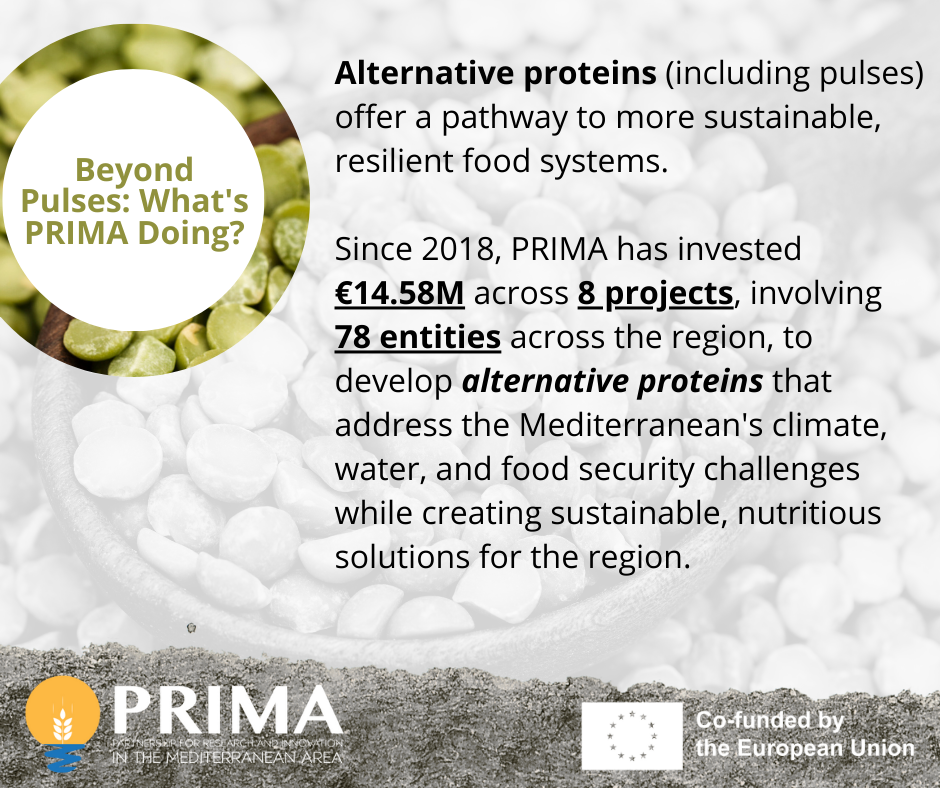
Since 2018, PRIMA has funded 8 projects on alternative proteins, representing a total budget of €14.58 million and involving 78 entities across the Mediterranean. These investments support the development of safe, nutritious, culturally acceptable, and affordable protein solutions, while creating new economic opportunities and reinforcing the sustainability of Mediterranean agri-food systems.