EVENT AT A GLANCE
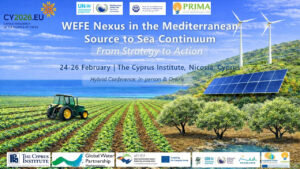
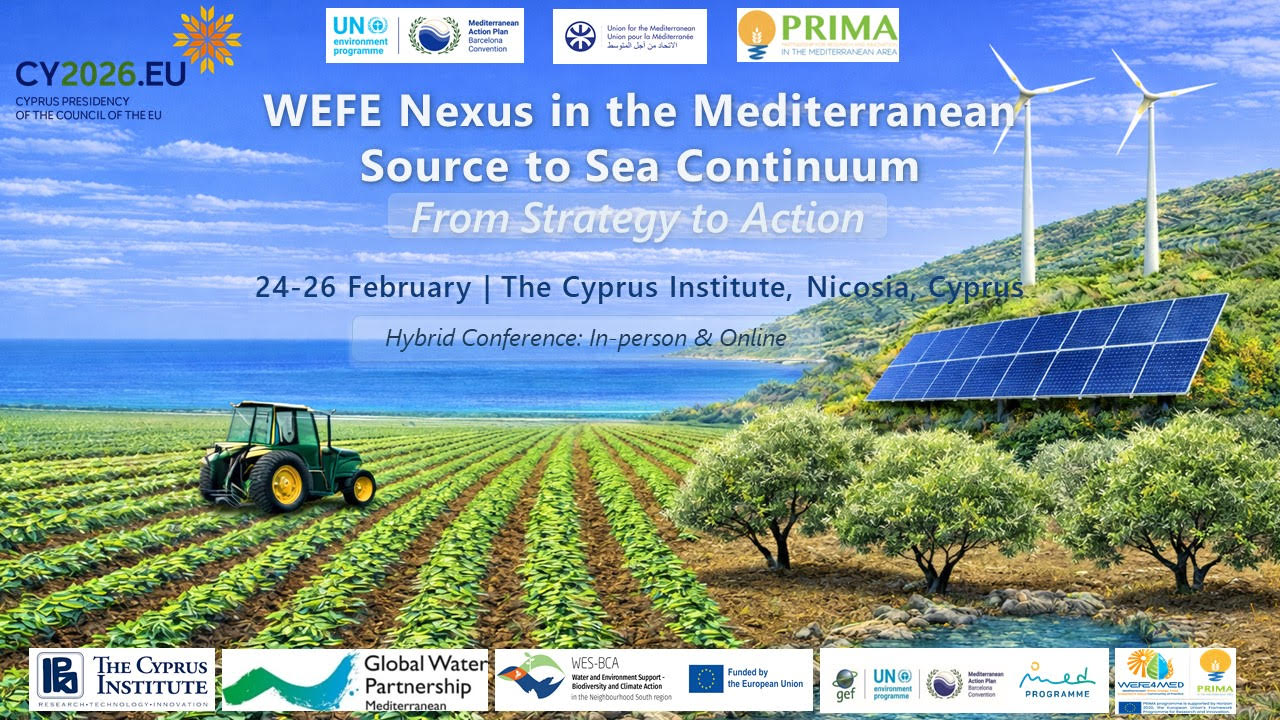
Date: February 24–26, 2026
Location: Nicosia, Cyprus (Hybrid)
Organised by: Union for the Mediterranean (UfM), UNEP/MAP, PRIMA — under the auspices of the Cyprus Presidency of the Council of the EU
PRIMA representatives: Octavi Quintana Trias (PRIMA Director), Ali Rhouma (PRIMA Project officer, will contribute online)
Framework: PRIMA project WEFE4MED and GEF MedProgramme
Agenda: Here
23 February 2026 | From 24 to 26 February 2026, Nicosia will host a decisive Mediterranean gathering with a spotlight on the Water–Energy–Food–Ecosystems (WEFE). Under the Cyprus Presidency of the Council of the European Union, the meeting will bring together decision-makers, researchers, investors and practitioners with a clear purpose: turning alignment into execution.
Prepared jointly with the Union for the Mediterranean, UNEP/MAP and PRIMA, and situated within the WEFE4MED and GEF MedProgramme frameworks, the conference will mark a shift for the WEFE Nexus.
Building on the momentum of the 2021 WEFE Nexus Science Advances Conference, the Conference will catalyse coordinated action for integrated natural resource management and regional water, food and energy security by advancing implementation of the WEFE Nexus Strategy across the Mediterranean Source-to-Sea continuum.
It will refine the technical foundations of an operational Action Framework, showcase concrete regional applications and measurable pilot results, strengthen the design and bankability of Nexus investments, and enhance alignment with broader climate resilience efforts, including the Eastern Mediterranean and Middle East Climate Change Initiative.
From strategy to implementation
The Mediterranean WEFE Nexus Strategy S2S continuum outlines a systemic approach that replaces sectoral silos with a connected reading of resources, tracking water, energy, food systems and ecosystems as interdependent components of one continuum. Developed under the leadership of the Union for the Mediterranean, the European Commission and UNEP/MAP, with strong technical input from PRIMA and regional partners, it calls for coordinated planning, climate-smart investment, shared metrics and financing models designed for integrated solutions.
In Nicosia, attention will turn to implementation: governance, institutional alignment and the financial architecture required to move beyond pilot scale.
PRIMA: grounding the Nexus in practice
PRIMA has been among the earliest Mediterranean initiatives to give operational meaning to the WEFE Nexus.
The first dedicated call in 2019 supported Research and Innovation Actions, laying the analytical and scientific groundwork necessary to understand water–energy–food–ecosystem interdependencies. Modelling platforms, system analysis tools and integrated assessment frameworks provided the evidence base.
Yet science alone does not transform governance.
Recognising this, PRIMA progressively shifted towards Innovation Actions, supporting pilot sites, technological demonstrations, Nature-Based Solutions and governance experiments under real Mediterranean conditions. The goal has been constant: show decision-makers that integrated approaches are not theoretical ideals, but viable, cost-efficient responses to scarcity and climate stress.
To reinforce this transition, PRIMA funded a Mediterranean WEFE Nexus Community of Practice under the WEFE4MED project (CSA), connecting projects, practitioners, policymakers and investors. This structured network fosters peer learning, encourages replication and strengthens cross-country alignment.
At the Nicosia conference, PRIMA will be represented by its Director Octavi Quintana, reaffirming the programme’s institutional commitment. Ali Rhouma will present the paper he contributed to“Financing the Water-Energy-Food-Ecosystem Nexus project: challenges, opportunities, and pathways for sustainable investment”*, addressing one of the most pressing barriers to scaling integrated solutions: investment.
Making the Nexus structural
The WEFE approach is no longer confined to a thematic call within PRIMA. It now informs the entire architecture of the programme. Projects in water management, sustainable farming and agri-food value chain are expected to examine cross-sector impacts, strengthen ecosystem resilience and connect scientific results with policy and investment decisions.
As PRIMA advances its future Strategic Research and Innovation Agenda under Future4PRIMA, the Nexus perspective will increasingly shape priorities and funding orientations. Standardisation, shared indicators, interoperable data systems and comparable impact metrics, will play a central role in strengthening investor confidence and regional policy coherence.
From demonstration to deployment
Across the Mediterranean basin, PRIMA-supported initiatives illustrate what integration looks like in practice: resilient irrigation systems, renewable energy embedded in agri-food chains, watershed restoration through Nature-Based Solutions, digital planning tools and participatory governance models.
These experiences will generate evidence. Yet evidence alone will not guarantee scale. Institutional fragmentation, regulatory uncertainty and limited blended finance instruments continue to constrain systemic deployment.
Scaling the WEFE Nexus will therefore require deliberate reform, policy alignment, clearer impact measurement, public–private cooperation and financial mechanisms capable of valuing environmental co-benefits.
A turning point
The Mediterranean faces intensifying stress: declining water availability, energy transition pressures, fragile food systems and degraded ecosystems. Addressing these pressures separately is no longer realistic.
In Nicosia, the region will take a step toward operational coherence. For PRIMA, the next phase will focus on consolidating alliances, mobilising capital and embedding integrated practice across the Source-to-Sea continuum, transforming coordination from principle into measurable progress.
Rhouma A, Daher B, Vrachioli M, Mohtar R and Gil JM (2025) Financing the Water-Energy-Food-Ecosystem Nexus project: challenges, opportunities, and pathways for sustainable investment. Front. Sustain. Resour. Manag. 4:1590161. doi: 10.3389/fsrma.2025.1590161