
What Are Key Exploitable Results?
In research programs, it’s not enough to simply generate knowledge. The real value lies in creating results that can actually be used by those who need them. This is the idea behind Key Exploitable Results, or KERs.
KERs are the most practical and promising outcomes from PRIMA-funded research projects. They represent innovations and knowledge that are ready to move beyond the research phase and into real-world application, whether that means commercialization, adoption by farmers, use by policymakers, or implementation by communities.
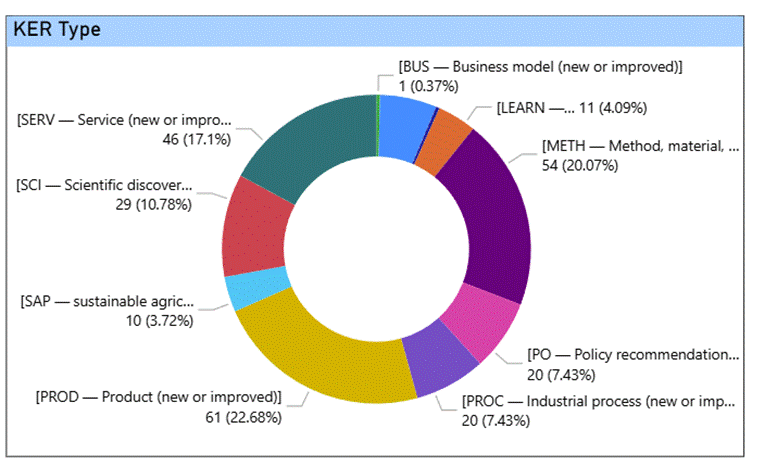
Recently, PRIMA has been analyzing the key exploitable results (KERs) of projects that have reached their final stages (projects funded in 2018, 2019 and 2020) and have been technically validated by the PRIMA Secretariat. A total of 271 KERs have been generated from 86 completed projects.
Based on this first analysis, PRIMA findings show that KERs take different forms. About half are tangible outputs: products (22.7%), methods and tools (20.1%), industrial processes (7.4%), and agricultural practices (3.7%). The other half consists of non-tangible outputs like services (17.1%), scientific discoveries (10.8%), policy recommendations (7.4%), and learning tools (4.1%).
Why KERs Matter
KERs serve as a bridge between research and impact. Many research projects produce interesting findings that never leave the academic world. KERs are different—they’re designed from the start to be exploitable.
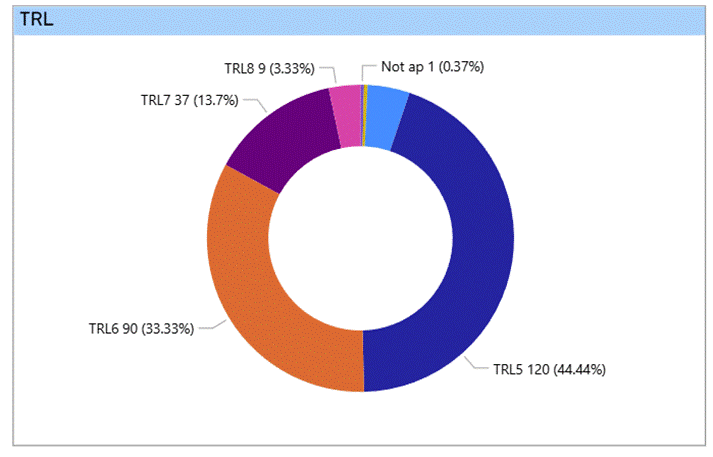
The data shows this approach is working. Most PRIMA KERs have reached solid levels of technological maturity. About 45% are at Technology Readiness Level 5, meaning they’ve been validated in relevant environments. Another 33% have reached TRL 6, with prototypes demonstrated in real conditions. Some 13.7% achieved TRL 7 (operational prototypes), and a few reached TRL 8 (complete systems). This means these innovations are moving beyond the laboratory and toward practical use.
Who Benefits from KERs?
PRIMA’s KERs are designed with specific end-users in mind. The main beneficiaries include farmers, producers, researchers, and government authorities. But the network extends further to companies, cooperatives, manufacturers, irrigation agencies, policymakers, SMEs, consumers, and advisory services. This diversity means that innovations can reach those who need them through multiple channels.
PRIMA’s KER Portfolio: An Overview
From 86 completed PRIMA projects involving 779 beneficiaries across 19 participating states, with a combined budget of 107 million euros, the program has generated 271 Key Exploitable Results. This represents an average of more than three exploitable results per project.
These 86 projects are distributed across four main areas:
Water Management (24 projects, 72 KERs): These projects focus on integrated water management, irrigation solutions, groundwater management, and water treatment and reuse. Most KERs take the form of services and methods, practical management tools, monitoring platforms, and decision-support systems. Many target communities, NGOs, and the general public, reflecting the importance of local engagement in water management.
Farming Systems (36 projects): This is the largest group, addressing agroecology practices, crop resilience to stress, disease control, and greenhouse and aquaponic systems. The KERs are mainly products, methods, and services, with most directed toward farmers and the agricultural sector. This confirms that practical applicability drives these projects.
Agro-Food Value Chain (22 projects): These projects work on traceability and authenticity platforms, food processing technologies, valorization of by-products, shelf-life extension, and the Mediterranean diet. Product-oriented KERs dominate here, showing strong readiness for commercial uptake.
WEFE Nexus (4 projects): These cross-cutting projects focus on the water-energy-food-ecosystem interface. Most of their KERs are learning tools, guidelines, and knowledge platforms designed to help different stakeholders work together and manage interconnected resources. Many target communities and the general public, emphasizing the participatory nature of this approach.
The Strategic Value of KERs
KERs demonstrate that PRIMA’s partnership model works. By generating exploitable results that benefit all participating countries, the program shows that research collaboration can create shared value across the Mediterranean region.
It is important to highlight that KERs help build lasting networks. By involving researchers, farmers, companies, policymakers, and communities in the exploitation process, these results create collaborations that continue beyond individual projects.
Looking Ahead
The 271 KERs from PRIMA’s first completed projects are just the beginning. The program has funded 269 projects since 2018, with approximately 400 million euros allocated, involving 2,586 beneficiaries. As these projects conclude, many more exploitable results will emerge.
The next step is ensuring these results reach their full potential. This means supporting innovations as they move toward market readiness, strengthening knowledge transfer to end-users, creating enabling policy frameworks, and building capacity so that communities and practitioners can effectively use new tools and methods.