PRIMA Award | From Abandoned Fields to Living Soils: How Andrea Abad Bartolomé is rebuilding Mediterranean Agriculture
Published on
Interview | Andrea Abad Bartolome (Terra Viva Ibiza, TVI), Spain.
In the heart of the Mediterranean, abandoned farmland and water scarcity threaten the future of local food systems. Through Terra Viva Ibiza, one woman is demonstrating how regenerative agriculture, smart water management, and farmer-led innovation can restore soils, strengthen communities, and build climate resilience.
Meet Andrea Abad Bartolomé, one of the two winners of the PRIMA Award for Women Greening Food Systems in the Mediterranean. By combining traditional knowledge, open-source technology, and practical education, her work shows that the regeneration of Mediterranean agriculture is not only possible, but essential. Read her story:
“I never expected to become a farmer. But when I realized how deeply out of balance our relationship with food and nature had become, I knew my own life had to change. Quitting my old career and deciding to travel through Australia led me to discover permaculture and the realization that we, as humans, have both the power and the capacity to reinsert ourselves into the cycle of nature. While farming quickly became my passion, I never imagined it would one day become my livelihood.
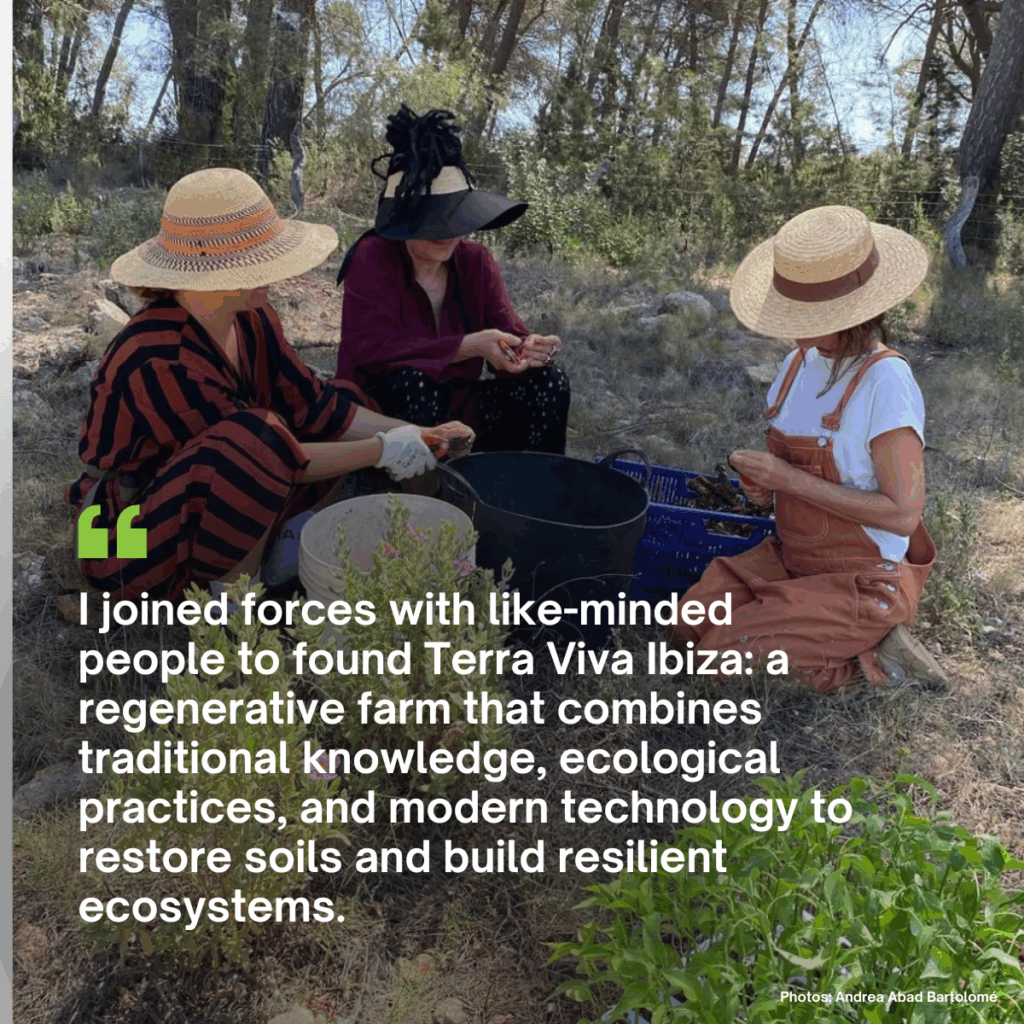
With no previous experience in commercial farming, yet increasingly concerned about the impacts of the industrial food system, I joined forces with like-minded people to found Terra Viva Ibiza: a regenerative farm dedicated to demonstrating an approach to agriculture that blends traditional knowledge, ecological observation, and modern technological and educational tools to reverse soil degradation and cultivate resilient, abundant ecosystems.
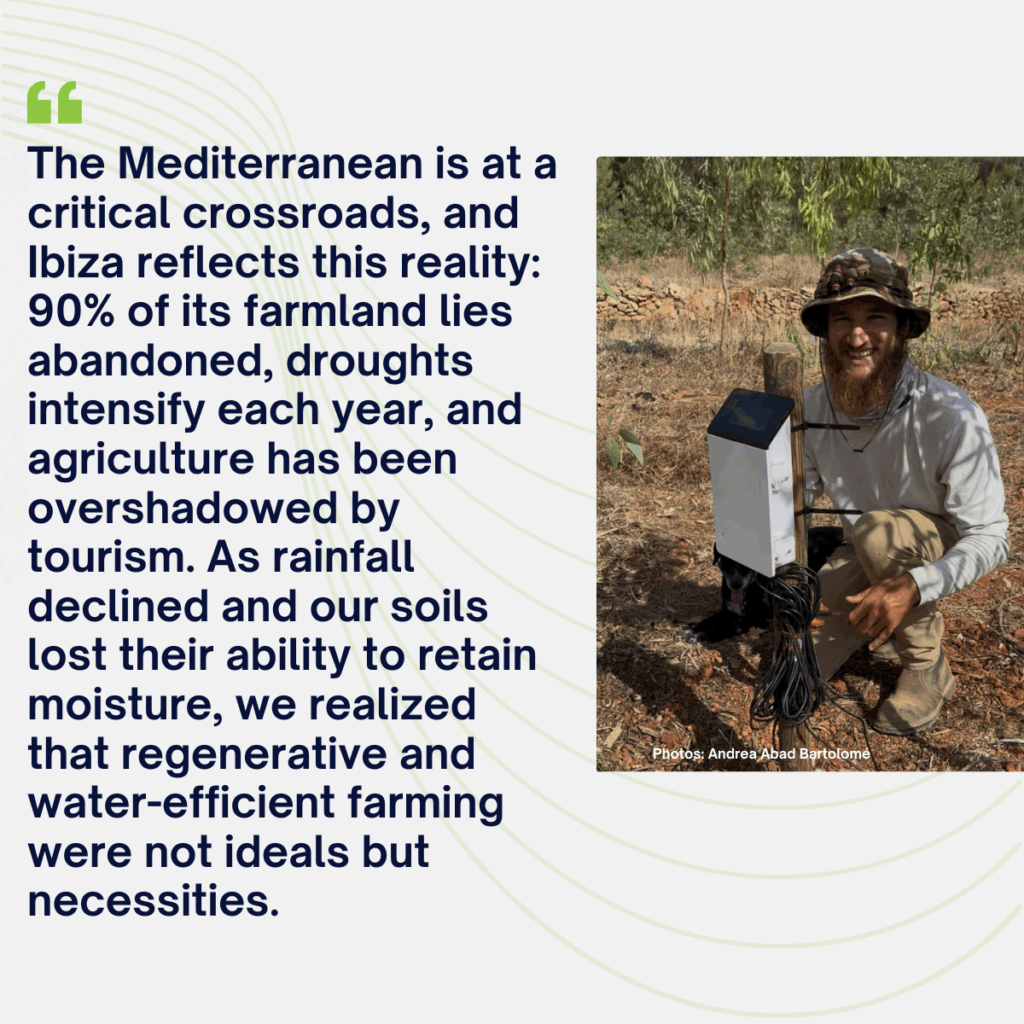
The Mediterranean is at a critical crossroads, and Ibiza reflects this reality: 90% of its farmland lies abandoned, droughts intensify each year, and agriculture has been overshadowed by tourism. As rainfall declined and our soils lost their ability to retain moisture, we realized that regenerative and water-efficient farming were not ideals but necessities. This realization sparked our commitment to demonstrating that there is still hope in securing the island’s food future.
We began with great enthusiasm and limited experience. We grew quickly, diversifying into vegetables, pasture-raised chickens, and syntropic agroforestry. We offered practical farming sessions and weekly workshops and bore witness to an undeniable desire among the community to reconnect with nature. Yet, as the project expanded, we faced significant challenges. Our well began to run dry, rainfall became increasingly scarce, operational costs rose, the commercialization of our products proved difficult for a small team, and all while administrative support remained limited.
These struggles revealed the main barriers preventing Mediterranean farmers from adopting regenerative and water-efficient practices. The first is economic pressure: small farms operate with extremely constrained margins, making experimentation risky. The second is technical and administrative complexity, as many available tools, regulations, and bureaucratic processes are designed for industrial-scale agriculture, leaving smaller farms without accessible or adaptable pathways. The third barrier is isolation: farmers often work alone, without collective support.
We simply could not stand still, so we went head-on to address these challenges by focusing on practical, farmer-centered solutions. This led us to our first major collaboration. Together with a software agency, and with support from CESAM, we began developing Open Ceres: an open-source smart irrigation platform created by small farmers to support small farmers. The system integrates soil-moisture sensors compatible with different brands and price points, offers clear explanations of each data point while guiding farmers on when to irrigate, and provides direct evidence of the impact of every decision by calculating both water savings and cost efficiencies. After testing this system at Terra Viva, we reduced irrigation by over 60% during the critical summer–autumn period and discovered that winter irrigation was unnecessary, saving 100% of our water during that season. This level of clarity and support in decision-making is transformative for Mediterranean farmers facing climate stress.
Our second major project was inspired by our early lack of knowledge, which became one of the strongest motivations behind creating TerraCert: an Erasmus+ project subsidized by the European Commission that offers the practical, competency-based training we wished we had received in the early days. The courses cover regenerative practices, pasture management, agroforestry, mushroom cultivation, beekeeping, microbiology, bookkeeping, branding, marketing, and more. Each course leads to a Europass-validated micro-credential, giving farmers and aspiring farmers recognized skills that strengthen both their livelihoods and their confidence. Led by Terra Viva and developed by a consortium of ten partners across Spain, Greece, Italy, France, and Poland, TerraCert is designed to shape the next generation of regenerative farmers across Europe and the Mediterranean: professionals who are technically skilled, officially certified, ecologically aware, and valued for their essential contribution to society.
Yet, even the best education and technology cannot transform the food system without collaboration. The exchange of knowledge, shared experiences, and peer-to-peer support is essential to overcoming the fragmentation that has long characterized agriculture. Farmers face similar challenges, yet too often face them alone. As a member of the board of the Organic Farmers’ Association of Ibiza (APAEF), my aim is to strengthen our collective capacity, encourage unity among farms, and build a shared voice capable of advocating for laws that genuinely protect and support farmers. By creating mechanisms to learn from one another, collaborate in distribution and logistics, and reinforce each farm’s unique identity, agriculture can reclaim its central role in society.
Overall, we must not forget a simple truth: farmers are the foundation of our society. We work every day against climatic, economic, and structural pressures to nourish our communities and care for our landscapes. Projects like Terra Viva Ibiza, Open Ceres, and TerraCert exist to make that work more viable, more valued, and more visible, but the transformation of our food systems cannot rest on farmers alone. Regenerating the Mediterranean requires the support of everyone, regardless of their profession or skill set. When different sectors stand behind those who care for the land, meaningful change becomes not only possible but inevitable.
Just as cooks evolved into chefs, gaining recognition, respect, and cultural value, it is time for farmers to be acknowledged as the backbone of our food system. Without them, without us, there is no future. Let us support our farmers so that, together, we can build a sustainable, abundant, and healthy future.”
Andrea Abad Bartolomé is one of two winners of the 2025 PRIMA Award for Women Greening Food Systems in the Mediterranean, recognizing great contributions to biodiversity conservation and sustainable agricultural development in the region.
We use cookies on our website to give you the most relevant experience by remembering your preferences and repeat visits. By clicking “Accept All”, you consent to the use of ALL the cookies. However, you may visit "Cookie Settings" to provide a controlled consent.
This website uses cookies to improve your experience while you navigate through the website. Out of these, the cookies that are categorized as necessary are stored on your browser as they are essential for the working of basic functionalities of the website. We also use third-party cookies that help us analyze and understand how you use this website. These cookies will be stored in your browser only with your consent. You also have the option to opt-out of these cookies. But opting out of some of these cookies may affect your browsing experience.
Necessary cookies are absolutely essential for the website to function properly. These cookies ensure basic functionalities and security features of the website, anonymously.
Cookie
Duration
Description
cookielawinfo-checkbox-analytics
11 months
This cookie is set by GDPR Cookie Consent plugin. The cookie is used to store the user consent for the cookies in the category "Analytics".
cookielawinfo-checkbox-functional
11 months
The cookie is set by GDPR cookie consent to record the user consent for the cookies in the category "Functional".
cookielawinfo-checkbox-necessary
11 months
This cookie is set by GDPR Cookie Consent plugin. The cookies is used to store the user consent for the cookies in the category "Necessary".
cookielawinfo-checkbox-others
11 months
This cookie is set by GDPR Cookie Consent plugin. The cookie is used to store the user consent for the cookies in the category "Other.
cookielawinfo-checkbox-performance
11 months
This cookie is set by GDPR Cookie Consent plugin. The cookie is used to store the user consent for the cookies in the category "Performance".
viewed_cookie_policy
11 months
The cookie is set by the GDPR Cookie Consent plugin and is used to store whether or not user has consented to the use of cookies. It does not store any personal data.
Functional cookies help to perform certain functionalities like sharing the content of the website on social media platforms, collect feedbacks, and other third-party features.
Performance cookies are used to understand and analyze the key performance indexes of the website which helps in delivering a better user experience for the visitors.
Analytical cookies are used to understand how visitors interact with the website. These cookies help provide information on metrics the number of visitors, bounce rate, traffic source, etc.
Advertisement cookies are used to provide visitors with relevant ads and marketing campaigns. These cookies track visitors across websites and collect information to provide customized ads.