
Interview | Kaoutar Aboukhalid (Institut National de la Recherche Agronomique), Morocco.
In the mountains of Morocco, a precious plant is vanishing. Dr. Kaoutar Aboukhalid is working to save it, one community at a time. As one of the two winners of the PRIMA Award for Women Greening Food Systems in the Mediterranean, Dr. Aboukhalid’s MOROREGEN project demonstrates that science, local knowledge, and women’s leadership can help reverse biodiversity loss.
We have interviewed her.
What first motivated you to start the MOROREGEN project, and when did you realize that Morocco’s native oregano species were at real risk?
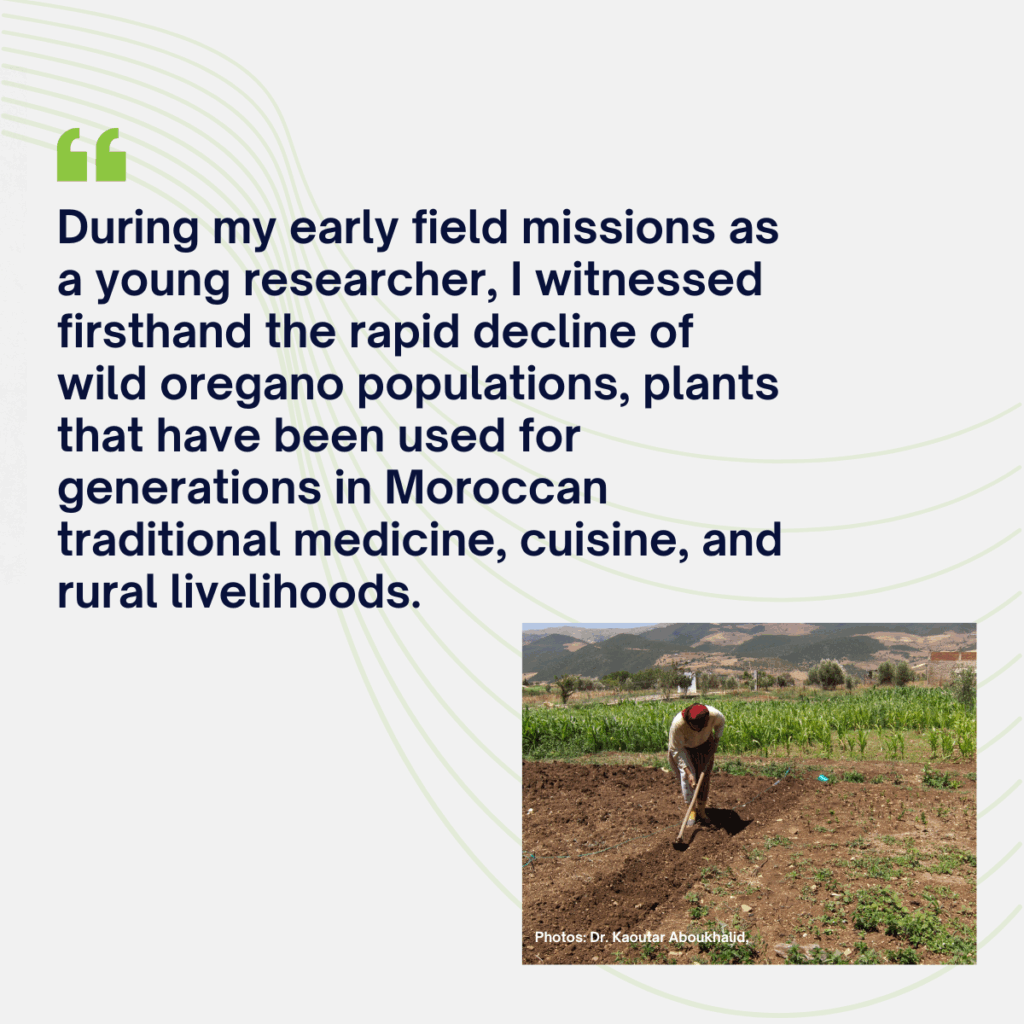
My motivation for launching MOROREGEN came from a combination of scientific curiosity and a deep sense of responsibility toward Morocco’s unique botanical heritage. During my early field missions as a young researcher, I witnessed firsthand the rapid decline of wild oregano populations, plants that have been used for generations in Moroccan traditional medicine, cuisine, and rural livelihoods. In addition to their traditional therapeutic uses, particularly for digestive and pulmonary disorders, these plants are recognized for their antifungal, antimicrobial, and antioxidant properties.
What struck me most was how quickly natural habitats were changing. Overharvesting, grazing pressure, uncontrolled commercialization, and climate-driven degradation were reducing both the abundance and the genetic diversity of these species. Field observations indicate a pronounced and accelerating decline in natural oregano populations across Morocco due to overexploitation, grazing pressure, uncontrolled commercial use, and climate change, leading to reduced population sizes and loss of genetic diversity. In many areas, return visits to previously recorded locations showed that oregano populations had tended toward complete extinction. This highlighted the serious risk of genetic extinction faced by Morocco’s endemic oregano species: Origanum compactum, O. elongatum, and O. grosii.
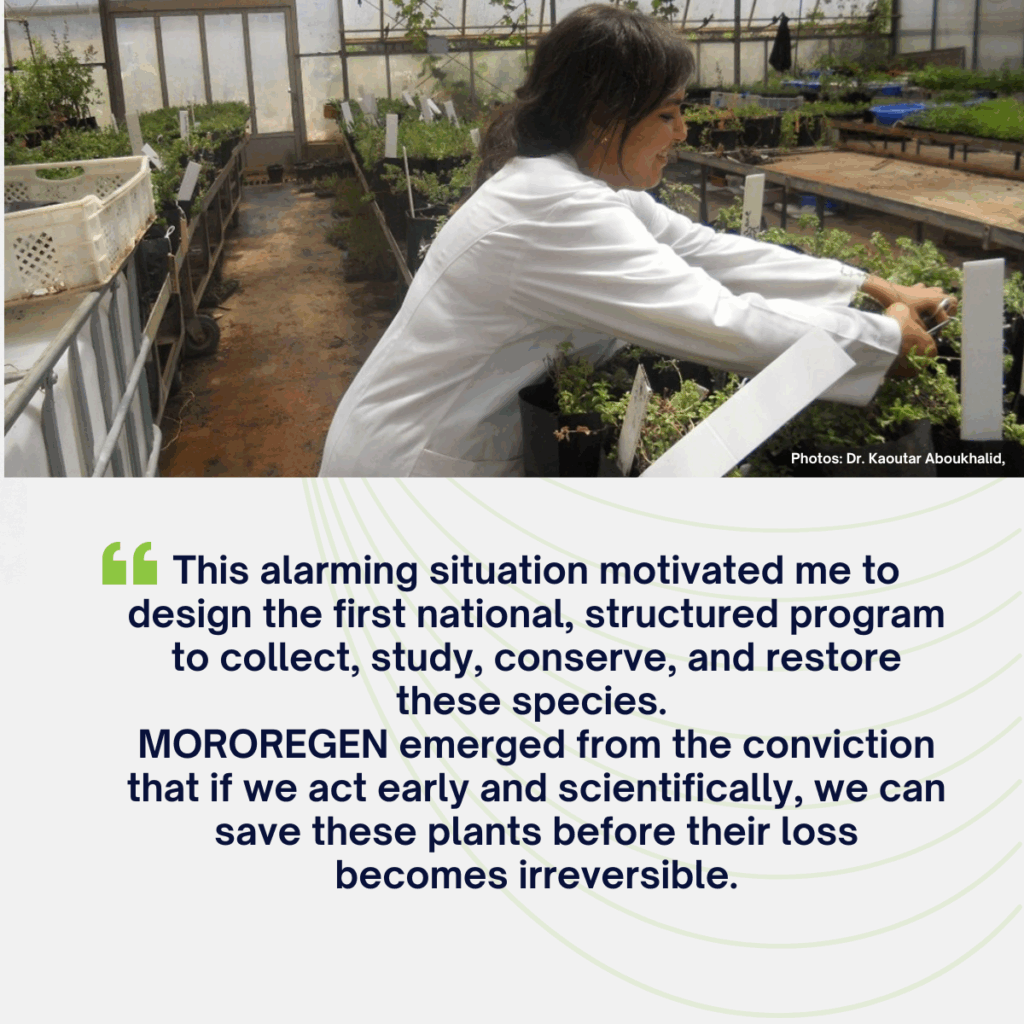
This alarming situation motivated me to design the first national, structured program to collect, study, conserve, and restore these species. MOROREGEN emerged from the conviction that if we act early and scientifically, we can save these plants before their loss becomes irreversible. The project is not only about preserving a plant; it is about safeguarding cultural heritage, biodiversity, and future economic opportunities for rural communities.
In your view, how can local communities and their traditional knowledge help protect and restore these endangered oregano plants?
By valuing local knowledge, we ensure that conservation is not imposed from the outside; instead, it becomes a shared, community-driven effort that respects tradition while integrating modern science.
For Morocco’s oregano, local communities play an essential role in conservation. For centuries, they have known how the plant grows and how it should be harvested and used. This knowledge works in tandem with scientific research. Within MOROREGEN, interaction with local harvesters and women’s cooperatives became paramount to conservation efforts through:
- Traditional ecological knowledge: Communities understand the best harvesting periods, regeneration processes, and environmental niches where oregano thrives.
- Sustainable harvesting: With appropriate training and empowerment, communities can shift from uprooting plants to selective cutting, allowing natural regeneration.
- Propagation and cultivation: The involvement of female farmers has proven effective in adapting and cultivating domesticated, high-value oregano varieties, thereby reducing pressure on wild populations.
- Community-based restoration: Seed collection from diverse populations and planting in degraded areas are facilitated through community involvement.
This recognition of local knowledge ensures that conservation efforts are community-led rather than externally imposed, combining tradition with modern scientific approaches.
How do you hope your work, and the role of women in leading it, will influence the future of biodiversity and sustainable agriculture in the Mediterranean?
I hope that MOROREGEN demonstrates how women-led science can drive meaningful change in biodiversity conservation and sustainable agriculture. Across the Mediterranean, women play a central role in natural resource management, yet their leadership often remains under-recognized. Through this project, I wanted to show that women researchers can design ambitious scientific programs, lead multidisciplinary teams, and create solutions that are both environmentally and socially transformative.
The project aims to inspire the next generation of women scientists, students, farmers, and entrepreneurs to contribute to biodiversity conservation and the development of more environmentally friendly food systems. The approaches developed within MOROREGEN for the domestication and restoration of medicinal plant species offer a valuable model for other threatened medicinal plants in the region. This research promotes more resilient, biodiversity-compatible food systems through scientific innovation, conservation strategies, and the empowerment of women.
Ultimately, the project aspires to contribute to a Mediterranean future in which biodiversity is seen not as a limitation, but as an opportunity, one that supports sustainable, climate-smart agriculture through the leadership and knowledge of women.
—–
Dr. Kaoutar Aboukhalid is one of two winners of the 2025 PRIMA Award for Women Greening Food Systems in the Mediterranean, recognizing great contributions to biodiversity conservation and sustainable agricultural development in the region.